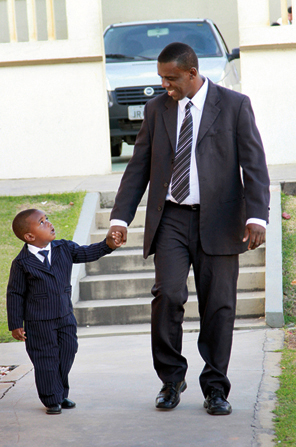
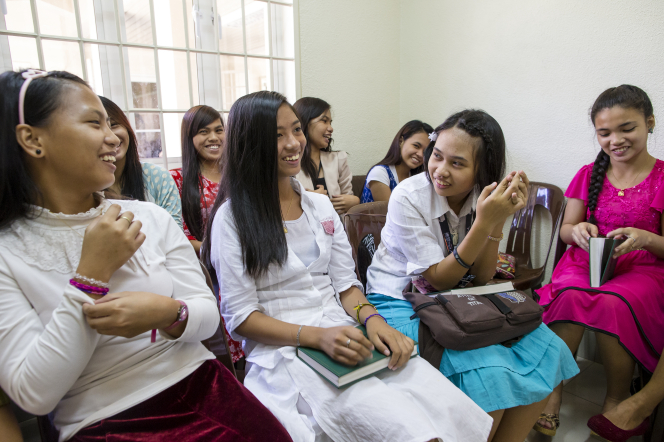
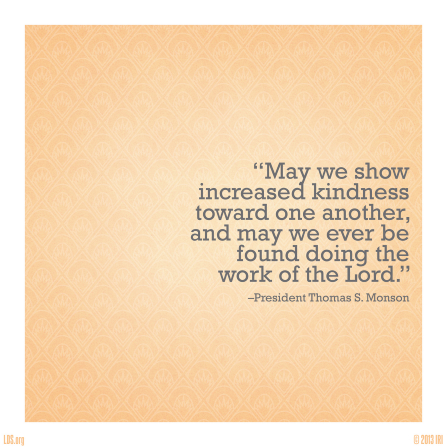
In the book of Matthew, the Savior teaches that the greatest in the kingdom of God are those who humbly love and serve.
"But he that is greatest among you shall be your servant" (Matt. 23:11).
Who better to serve as an example of loving service than Christ himself? Even though He was the literal Prince of Peace, and son of the Everlasting Father, he did not allow status or pride to control his actions. He did not look down on the beggar or the sinner, but reached out to them and offered them peace, comfort, healing, and forgiveness. In further clarification to his teachings and example, he offered this warning...
"And because iniquity shall abound, the love of many shall wax cold" (Matt. 24:12).
Lack of love, or hatred, breeds iniquity and selfishness. How much better off would the world be with a little extra love? The Savior responded to the hypocritical pharisees, that their pride and boastfulness would not bring them acceptance from God. Rather, even leaders like them, or maybe even especially leaders like them, should serve and love those they teach. We can all think of that one manager or supervisor that no body likes because they are power hungry and condescending. We are much more likely to happily comply with the one who shows us equal respect and understanding. Love breeds love. Some might call it Karma. No matter how you say it, there is no disputing that when someone does something nice for you, you feel happier and then you have an increased desire to pay it forward to the next guy. In addition to putting us in a better mood, kindness creates a ripple effect. It doesnt matter if we serve our boss or our child. The act of service is the same.
Dieter F. Uchdorf once stated:
"The more I come to know my Heavenly Father, the more I see how He
inspires and leads His children. He is not angry, vengeful, or
retaliatory. His very purpose—His work and His glory—is to mentor us, exalt us, and lead us to His fulness."
Let us all try a little more to imitate the love of the Savior. Be a little more kind, more forgiving, more patient...less boastful, less arrogant, less angry. The world could sure use it.
Prayer has always been a very
personal act for me and I have never really felt comfortable praying out loud,
especially in front a lot of people. It wasn’t something that I remember doing
very often growing up. We would most often pray over our dinner as a family,
but I remember prayer being mainly something we did at church. I would
occasionally say my own personal prayers, like when my mom passed away and I
was seeking comfort. Maybe these personal pleadings are what influenced my
feelings towards the act of prayer as a very intimate practice that I did not
like others to hear.
When I got married, my husband
wanted to say prayers as a couple each night before bed. I’m not going to lie,
saying a prayer out loud with him is still a bit uncomfortable for me, even
after 18 years of marriage. Over time, however, it has become easier and I can
look back and see how it has strengthened our relationships and guided us in
the decisions we have made regarding our family. Praying regularly as a couple,
a family, and an individual, is something that is highly encouraged by the
leaders of my church. Prayer is one of the most important gifts we have been
given as it is a way to talk with God and receive answers, comfort, and
guidance from Him as our loving Father. But prayer also does more than this; it
changes our heart. President of the LDS church, Thomas S. Monson, shared a piece
of advice he was given when he was married to his wife. They were taught:
Most married couples will tell
you that marriage is hard, myself included. I have had moments of frustration,
anger, and annoyance with my husband. When I do nothing to resolve these negative
feelings, naturally they get worse. I have discovered that the only way to make
them go away is to pray for understanding and a softened heart. Regular prayer
for my husband and our relationship makes a world of difference. When I pray
for him, I have an increased desire to serve him, and my love and appreciation
for him increases. It allows me to view him closer to the way that God views
him.
Praying together has also allowed
us to counsel with the Lord in the decisions we make for our family, and to
find answers regarding the individual needs of our children. Nathan M. Lambert
stated that “prayer is the means by which individuals may invite God to play an
active role in their relationship.” It
gives me great comfort and assurance to know that we have God on our side, and
that he provides us with answers for raising our family and strengthening our
marriage. We also pray each night with our
children and over every dinner together. This has helped them to know how to
talk with God and rely on Him in times of need and gratitude. A few years ago,
we were cooped up in the basement awaiting the outcome of a tornado warning for
the area. One of my kids is especially fearful of tornadoes and you could see
her struggling with this anxiety. After singing, playing games, and telling
stories failed to calm her fears, my sweet daughter suggested that we say a
prayer to keep us safe. After saying her short but sincere prayer, my daughter
started to relax and soon after the warning was lifted, and we were able to go
back upstairs. How amazing it was to witness the faith of my children, who knew
that their Father in Heaven would hear and answer their prayers. This has been
a blessing many times in our lives as they have struggled with school, friends,
and other challenges. I personally have felt the peace and comfort of the
Savior as I have come to rely on Him for relief from my burdens. The saying “families
that pray together, stay together” really rings true for us. We live in a
confusing time with much turmoil and temptations. Prayer has kept us safe from
the literal and figurative tornadoes that face us. I am so grateful that I have
learned to rely on prayer, and I hope that each of you get to experience that
same peace and happiness in your life as you develop a relationship with our
Father in Heaven.
Many times, my family and I will be sitting on the couch in what would normally have been a perfect opportunity to socialize and bond, but with current trends, instead of paying attention to each other, our faces are all being lit up by the glow of our individual electronic devices. Even though we are all in the same room, and even on the same couch, we are absent. This isn't an uncommon scene. In fact, almost everywhere I go I notice people locked into the images on their phones, mindlessly scrolling in apparent boredom. This new "connection" to the social media world might foster distant relationships, but it is causing us to disconnect from our present ones.
While we might experience temporary pleasure from our favorite television shows, apps, and video games, research has found that "gratification results when we invest rather than consume" (Hawkins, 2012); and what would be better to invest in than our families? Family investments might include hiking, bike riding, learning a new skill, or just playing together. Rather than just spending all our time consuming, investing in constructive activities offers psychological and physical benefits for children and adults. Children who do chores and participate in extracurricular activities have been found to score "higher on measures of quality of life and subjective well being," than those who spend their time at the mall or playing video games (Seligman, 2002).
Author, Richard Louv described modern day individuals and families as being "disconnected from nature," or suffering from what he terms "nature deficit disorder," or NDD (2005). Where people used to spend ample amounts of time outdoors, we now spend it increasingly indoors with electronic media as our companions. To treat the symptoms of NDD, we can turn to the "Project Happy Hearts" web page, where we find 5 suggestions for "ways you can improve your physical, spiritual, and mental well being by taking advantage of nature’s restorative powers." As a family, try some of these suggestions which include:
Exercising outdoors: Go for a hike, swim in a lake, or take a walk along the beach.
Socializing outdoors: Have a barbecue, a picnic, go camping or play Frisbee together.
Meditating outdoors: Sit and watch the clouds, listen to the birds, or just enjoy the feeling of the warm sun and cool breeze on your face.
Louv further explains the direct influence nature has on our physical health. "Stress-reducing contact with nature can influence mental and emotional well-being."
Spending time outdoors is a great way to bond as a family, but it's not the only way. If we really desire fulfillment, gratification, and happiness in our
families, we need to seek out the most optimal activities that allow us to communicate, connect, and build unity. Family Vacations and regular meal times together are two great ways to achieve these things. We also want to make sure all family members get a chance to do something they enjoy. Something that has worked well for us is to have family councils before vacations. We discuss the possible activities that each person would like a chance to do, and then schedule a time to do them. We decided to go somewhere new, but not too far for spring break. All my kids enjoy camping so we will be spending a couple days at a new national park. A couple kids expressed interest in horseback riding, and my younger ones wanted a walk through a large park with a splash pad. My oldest daughter and I enjoy touring the area and walking through new shops. With a little planning, we were able to fit in at least one activity that everyone enjoys. We always build good family memories and strengthen our relationships when we do these things together. So, what are some things you enjoy doing as a family?
It is not uncommon to hear people reflect back to "the good ole' days," but what is it that makes the
past such an alluring time? We have so many new advances, machinery and
technology now, that you might wonder why anyone would want to go back
to a time without so many conveniences. Families used to have to wake at
the crack of dawn to get to work on the farm. Children would labor side
by side with their parents to milk cows, gather eggs, harvest fruits
and vegetables, make bread, and wash clothes by hand.
Grandparents
love to reminisce about their past history, which was often spent in
the company of parents and siblings. But, times started to change after
advances were made. Fathers were sent to work in factories and children
sent off to school for most of the day. Mothers were left to care for
the household with the replacement of new modern machines instead of
children. Changing laws, views and morals have gradually separated
family members from one another as they pursue their own individual
interests. This "Leave it to Beaver" lifestyle might seem perfect
to some. Sure, parents were authoritative, kids well-behaved, and generally speaking-
husbands and wives lived with respect for one another; but the share of
household duties became largely a woman's job. While mothers cooked and
cleaned, fathers worked and children played. Eventually, the woman's
movement even took mothers out of the home to labor in the workforce and
earn a few extra bucks to pay for extra conveniences and luxuries.
Hawkins et al.
states, "while the economic model values efficiency, independence, and
profit, the Lord teaches long-suffering, humility, and love unfeigned"
(2012). While societal norms have constantly changed to eventually drive
individuals and families away from each other, God's standards for
loving and united families has remained the same. Russell M. Nelson once
said:
“The home is a great laboratory of love. There
the raw chemicals of selfishness and greed are melded in the crucible of
cooperation to yield compassionate concern and love for one another"
(1999).
Families that work side by side
together are able to grow in
appreciation, love, and concern for one another. It has been found that
children who are responsible for self-care and family chores benefit by
gaining
valuable self-regulating skills and by learning to care for and think
about
others. Studies have also shown that children who do chores are more
likely to
"have more friends, and are less likely to disobey teachers, make
trouble
at school, or be depressed or withdrawn" (Coltrane, 2010). Maybe these
benefits are what makes the old times look so good. Families worked
together and became close knit as they served and helped one another.
They all took satisfaction in making their house a home, while at the
same time spending irreplaceable time together with their loved ones.
Think
back to the time spent with your family. When I do this, a large
portion of my fondest memories include working side by side with my
grandparents, parents and siblings. I loved to help Grandma cook in the
kitchen, can fruits and vegetables, and care for the garden. Grandpa let me help with feeding the animals, ride with him on the tractor and
horses, and watch him weld something for a neighbor. I learned valuable
lessons from spending time working with my grandparents. I also helped
my parents weed the garden, pick fruit from our trees and even build a
cabin together as a family in the mountains. One of my clearest and
favorite memories with my cousins was helping them clean the house while
we listened to music blasting loudly from the stereo. My siblings and I
also loved to have music playing in the background so we could sing
along while we did our chores. Even though at the time we hated chores, looking back on it now makes me grateful for the that time of bonding and working together.
When I got married and started a family
of my own, I was grateful for the skills I had learned growing up to
care for my own home and be able to cook meals. As
a mother, I am all too familiar with the common complaint of children who are
asked to clean their room or do their chores. Many times I think it
might just be easier for me to do it all on my own to prevent from
hearing the complaints and to make the job faster and done better. However, this would not benefit my family. Completing mundane
chores side by side with our children not only teaches them valuable
skills, but gives parents and children an opportunity to interact. It
sends the message to our children that they are valued and needed. They
are also more likely to complete chores happily when we are willing
to help them and make it fun. When our children were younger,
we used to make a game out of their chores. For example, we would have them
find and pick up all toys of a certain color, or see how fast they could
clean up. I have passed down the practice of blasting music throughout the house when its chore time. While society has changed in its views and practices
regarding family work, we can still apply the examples of our ancestors
and create stronger family bonds through working together.
Yesterday I read about the correlation between religion and happy,
successful families. I found it fascinating that studies have shown that
attending religious services more than once a week leads to a 7.6 year
increase in lifespan. Not only that, it correlates with lower rates of
abuse, pornography, infidelity, and depression. Shared religious beliefs
and involvement between spouses can strengthen marriage and leads to
less divorce. Fathers who attend church are also more involved and
committed to their children's lives. They parent with more emotional
warmth, kindness, and mercy.
Every
Sunday, my husband and I along with our 5 kids, go to a 3 hour church
service. When people hear that the Mormon church service lasts for 3
hours every Sunday, many are taken back. They might feel that this is
unnecessarily long and that they "couldn't do it." I guess this is just
what we are used to. During the first hour, we meet all together as one
congregation. We take the sacrament, sing hymns and members of the
congregation, including the youth, share sermons and testimony of Jesus
Christ and His gospel principles. The second hour, we meet in Sunday
School groups and have more interactive lessons tailored to each
specific age group. Children 11 and under go to primary or nursery,
teens go to their own classes split by age, and adults attend their own
class as well. The 3rd hour is divided up even more. Young women and
young men (12-18 years) each go to a group that focuses on their unique
challenges and capacities to become like the Savior. Likewise, adult
women and adult men also go to separate
classes
aimed at teaching them how to become better parents, spouses, neighbors
and disciples. The children are split into classes by age group. I love
that the members of our church get to receive not only messages as one
unified congregation, but also lessons tailored specifically to each
person according to their stage of life. I am a teacher for the 7 year
old class. Almost every member of our congregation is asked to serve the
church in some way, if they are willing and accept. No one gets paid to
be in these "callings," not monetarily any way. We feel it is our duty
to serve one another and we are compensated with many blessings and
increased knowledge and skills. We receive no formal training or
education to teach or lead. This is something else that many people find
surprising, but there is a saying from our prophet, Thomas S. Monson
that says:
"Whom the Lord
Calls, the Lord Qualifies.”
Our
callings allow us to serve and grow. Many times, we learn more in our
callings than those we teach and serve. It gives us a chance to be like
the Savior. I also serve as the 8-12 year old girls activity leader.
Every Tuesday night, the youth 8-18 get together for another activity to
build unity and faith in Christ. I plan activities for the young girls
group to help them learn new skills, talents, provide service for
others, strengthen gospel principles, encourage them to make goals and
good choices, and just get together with friends their age to have a
good time. These activities provide us with the opportunity to attend
religious services more than once a week, and help to keep us focused on
the Savior.
A
correlation between religious youth and greater optimism and well-being
has also been found. These youth also show less depression, anxiety,
and fear as well as the ability to cope better with challenges and
difficulties. I feel that all of the correlations I've read about are
not by accident. Going to church each week and serving in my callings
strengthens my faith, motivates me to do more good, helps me to feel the
love of God, appreciation for my Savior, and gives me a sense of
belonging. I do not have any family living close by. They are all at
least 1500 miles away. My church congregation is like a family. We learn
together, serve one another and are genuine friends. We not only share
the same values, but we bond over shared interests, challenges,
experiences and phases of life. We enjoy getting together as families to
eat, play and laugh. Something we have maybe all heard is the phrase
"It takes a village to raise a child." I am so grateful for my village
of people who love, serve to teach my children each week. I take comfort
in knowing I have back-up and support in the great responsibility of
parenthood as well as support from my Father in Heaven who has my back.
When I am spiritually recharged and in tune each week, I have the
strength and will to keep moving forward, doing the best I can to be
closer to the Savior and have His spirit with me. I know myself and my
family receive blessings from doing these things.
The is a picture to the left is of my paternal grandparents, who both passed about 25 years ago. Even though it has been such a long time, I still have warm and fond memories of spending time with them. They lived about 6 hours south of us, but we would visit at least monthly. I can still remember the smell of their house and the taste of Grandma's homemade tomato soup.I remember helping Grandpa pick fruit from his garden and tend to his sheep in the field. Almost every time we visited, we would sit around the card table and play their favorite game of "Rook" while eating ice cream. The freezer was always stocked with buckets of ice cream.
The next pictures are of my maternal step grandparents, who have both been gone for about 8 years. They lived closer, only about 45 minutes north, so I would visit them often and they would visit us. I spent the night at their house several times. They had horses, bunnies and even pigs at any given time. I loved to ride the horses. They also had a motor home which we would take on scenic trips together. Grandpa was a welder and known in town as quite a guy. Grandma was the town Avon lady. She always looked and smelled her best. They both loved John Wayne movies and they would kiss after every prayer.
I am so grateful for the time I got to spend getting to know my grandparents. They taught me valuable lessons just by their examples. I'm sure I am a better person because of the time I spent with them. Research can back me up by showing that "children's perceptions of emotional closeness to their grandparents is related to reduced acting-out behaviors, such as promiscuity, drug abuse, and delinquency, and fewer symptoms of depression" (Hawkins, 2012). Time spent with grandparents is also linked to an increase in a desire to serve others. Its no wonder that 80% of people in the U.S. report the grandparent's role as extremely important. Many grandparents even adopt the role of primary caregivers, not an easy task. Children in these situations are usually taken from poor circumstances and do far better academically and socially when placed with their grandparents. You might describe these grandparents as heroes.
A grandparent's role does not just stop at their grandchildren. They also continue to offer support to their adult children. Some have even referred to them as "the family national guard" (Hagestad, 1985), since they step in during times of trial to offer assistance. Neil A. Maxwell explained that their roles change as they "put on their uniforms and actively provide help" in emergencies. When the crisis is over they "change back into their civilian clothes and resume a more typical relationship with their children and grandchildren."
My hope is to pass on the blessings of grandparents to my children, and hopefully they will do the same when its my turn to be a grandparent. My parents live more than just an hour, or six hours away...they live in a different state across the country. Its approximately a 30 hour drive to get to them. While they don't see them very often, we talk about them and to them regularly. Hopefully someday my children will be able to reflect back on the time they spent with them and have fond and happy memories like I do. These family bonds and support systems are so vital, yet often get taken for granted. So go and hug a parent or grandparent. They do more than you realize.
Moment of truth time. When my husband and I got married, we both
agreed that we did not want to use spanking as a form of punishment for
our future kids. However, while it has not been a regular occurrence,
there has been times I have lost my patience and swatted at my
children's behinds. No, I have not taken them over my knee or even hit
their bottom over and over, but I have spanked. In efforts to not break
our deal of spanking any more than I had to, I have also reached points
where I have been so angry that I back my kids into a corner and scream
at them. I am not proud of these times, and I always feel a strong sense
of guilt overcome me right after I have done this. I cant recall a time
when my husband has ever spanked, but we have both raised our voice on
several occasions. As a stay at home mom, I have spent more time with my
kids than my husband has, so naturally I have had more instances of
losing my temper. It ends with guilt, tears, and hurt every time and for all
involved.
In
my studies this week, I came across a quote from Brigham Young, the
second president and prophet of the church of Jesus Christ in these
latter-days. It said "I have seen more parents who were unable to control themselves than I ever saw who were unable to control their children." This is such a true story. It is easy to lose control
of my temper and all rational forms of thinking when my kids push all
the wrong buttons like talking back, ignoring my requests, or constantly
fighting with one another. As the parent though, I need to stay in
control so I can handle the situation appropriately. Acting in anger
sends the message that I don't care and creates fear in my kids. I have
seen this look of fear a couple of times and it is the worst.
Part
of authoritative parenting is providing reasonable expectations for our
children while enforcing firm, direct and consistent responses to their
behavior. As I learn more and more about parenting through my college
studies, I tend to feel inadequate for the task of all it takes to be
the "perfect parent." I feel guilty for all the things I have done wrong
over the years and fear that my kids will be facing psychological
consequences for all my mistakes. But something else I read this week
gave me some hope. Developmental psychologist Diana Baumrind,
explained that there is such a thing as "good enough" parenting. This
applies to parents who apply most of the principles of authoritative
parenting. Baumrind
states:
"Good enough, ordinary parents probably have the same effects on
their children's development as culturally defined super parents."
While we may not be perfect, as long as most of the elements of good
parenting are there, especially warmth and love, our kids will be okay.
Something else that always comes to mind when I lose my patience with my
kids, is a scripture that says "Reproving betimes with sharpness, when moved upon by the Holy Ghost; and then showing forth afterwards an increase of love toward him whom thou hast reproved, lest he esteem thee to be his enemy;" (D&C 121:43).
My husband is really great at this. He always goes in to talk to my
kids after he has lost his temper with them or had to apply strict
discipline. He always apologizes to them for losing his temper, and
makes sure they know he loves them. I am trying to follow his example in
this.
Another
parenting strategy that we agreed on before marriage was using time
out. We both took a child development class in college right after we
got married. We learned early about the principle of putting children in time out for 1 minute per year of age. Over the years I have also learned how to talk to, or not talk to our children while in time out (Watching "Super Nanny" might have helped, not gonna lie). I learned
it is best to not talk to them while they are in time out, but to wait
until their time is up. Then we go in, get down to their level and
explain to them in a calm manner why they needed a time out. This
strategy has worked pretty well for me over the years, and definitely
better than spanking or yelling. But, I have also learned
that sometimes I need a time out as well. If I find myself losing
control with anger and frustration, I will send both me and my child to
our separate rooms to cool down. Once I have relaxed a bit and given
myself time to think it through, I am able to come up with much more
appropriate consequences for my kids behavior. I can then go into their
room and have a rational and controlled conversation with them that
about their behavior and show forth that increase of love at the same
time.
I am painfully aware that my kids watch
my behavior and adopt my actions. They deal with frustrations in the
same way they have seen me deal with them. If they scream at each other,
I know they probably picked that up from me. I am not perfect by any
means, and I feel that most amazing mothers are hard on themselves when
it comes to trying to fit in the perfect mothering mold. We try to do it
all and this is partly what creates frustration and a lack of patience
with our kids. However, they also notice the good things we do and will
hopefully adopt those actions as well and forgive us for our faults. I
came across this short video a while ago, and related to it so much.
It's about 9 minutes long, but has a powerful message in the the end. We
never know how much good we do as parents, especially as we serve and
love them. We don't have to be perfect, we just have to try our best and
let our kids know we care.