Monday, February 20, 2017

Hope for better

Moment of truth time. When my husband and I got married, we both agreed that we did not want to use spanking as a form of punishment for our future kids. However, while it has not been a regular occurrence, there has been times I have lost my patience and swatted at my children's behinds. No, I have not taken them over my knee or even hit their bottom over and over, but I have spanked. In efforts to not break our deal of spanking any more than I had to, I have also reached points where I have been so angry that I back my kids into a corner and scream at them. I am not proud of these times, and I always feel a strong sense of guilt overcome me right after I have done this. I cant recall a time when my husband has ever spanked, but we have both raised our voice on several occasions. As a stay at home mom, I have spent more time with my kids than my husband has, so naturally I have had more instances of losing my temper. It ends with guilt, tears, and hurt every time and for all involved.

In my studies this week, I came across a quote from Brigham Young, the second president and prophet of the church of Jesus Christ in these latter-days. It said "I have seen more parents who were unable to control themselves than I ever saw who were unable to control their children." This is such a true story. It is easy to lose control of my temper and all rational forms of thinking when my kids push all the wrong buttons like talking back, ignoring my requests, or constantly fighting with one another. As the parent though, I need to stay in control so I can handle the situation appropriately. Acting in anger sends the message that I don't care and creates fear in my kids. I have seen this look of fear a couple of times and it is the worst.

Part of authoritative parenting is providing reasonable expectations for our children while enforcing firm, direct and consistent responses to their behavior. As I learn more and more about parenting through my college studies, I tend to feel inadequate for the task of all it takes to be the "perfect parent." I feel guilty for all the things I have done wrong over the years and fear that my kids will be facing psychological consequences for all my mistakes. But something else I read this week gave me some hope. Developmental psychologist Diana Baumrind, explained that there is such a thing as "good enough" parenting. This applies to parents who apply most of the principles of authoritative parenting. Baumrind states:
 "Good enough, ordinary parents probably have the same effects on their children's development as culturally defined super parents."
While we may not be perfect, as long as most of the elements of good parenting are there, especially warmth and love, our kids will be okay. Something else that always comes to mind when I lose my patience with my kids, is a scripture that says "Reproving betimes with sharpness, when moved upon by the Holy Ghost; and then showing forth afterwards an increase of love toward him whom thou hast reproved, lest he esteem thee to be his enemy;" (D&C 121:43). My husband is really great at this. He always goes in to talk to my kids after he has lost his temper with them or had to apply strict discipline. He always apologizes to them for losing his temper, and makes sure they know he loves them. I am trying to follow his example in this.

Another parenting strategy that we agreed on before marriage was using time out. We both took a child development class in college right after we got married. We learned early about the principle of putting children in time out for 1 minute per year of age. Over the years I have also learned how to talk to, or not talk to our children while in time out (Watching "Super Nanny" might have helped, not gonna lie). I learned it is best to not talk to them while they are in time out, but to wait until their time is up. Then we go in, get down to their level and explain to them in a calm manner why they needed a time out. This strategy has worked pretty well for me over the years, and definitely better than spanking or yelling. But, I have also learned that sometimes I need a time out as well. If I find myself losing control with anger and frustration, I will send both me and my child to our separate rooms to cool down. Once I have relaxed a bit and given myself time to think it through, I am able to come up with much more appropriate consequences for my kids behavior. I can then go into their room and have a rational and controlled conversation with them that about their behavior and show forth that increase of love at the same time.

I am painfully aware that my kids watch my behavior and adopt my actions. They deal with frustrations in the same way they have seen me deal with them. If they scream at each other, I know they probably picked that up from me. I am not perfect by any means, and I feel that most amazing mothers are hard on themselves when it comes to trying to fit in the perfect mothering mold. We try to do it all and this is partly what creates frustration and a lack of patience with our kids. However, they also notice the good things we do and will hopefully adopt those actions as well and forgive us for our faults. I came across this short video a while ago, and related to it so much. It's about 9 minutes long, but has a powerful message in the the end. We never know how much good we do as parents, especially as we serve and love them. We don't have to be perfect, we just have to try our best and let our kids know we care.

Tuesday, February 14, 2017

Mothering

The weirdest thing happened to me this morning. I came down the stairs and looked at the mess my kids had left from the night before...books strewn about, toys on the floor, dirty dishes, laundry...and I smiled. No, I have not gone insane...yet. The house was quiet and the kids off to school and I just thought to myself, "someday this will all be gone." And I don't mean the mess being gone, but the presence of the mess because that means that my kids are still here. The toys, the chaos, the mess, it all means that my kids are healthy, active, happy humans and I get to be in the moment of it all. Someday I will miss the toys on the floor and evidence of life in my home. But for today, I am going to cherish it. I love that I have a full nest and that I get to be fully involved in my kids lives as a stay at home mom.
Stay at home moms get a bad rep sometimes. Society does not seem to appreciate or value the work of mothers anymore. I feel that I am looked down on by some as being lazy or not fulfilling my potential as a women who has been given just as many rights as men. It seems I am not alone in this feeling. Surveys showed that less than "half of mothers (48%) felt appreciated most of the time, and almost 20% said they felt less valued by society when they became a mother" (M.F. Erickson & Aird, 2005). Some feel that working in a career is the best way for women to contribute to society and feel equal to the accomplishments of men. But I ask, who do these people think are going to be the future leaders of this world? Its not going to be the working mothers, it will be the children. The children are our future, and they have the best shot at being successful with devoted and loving mothers. I am not a slave to my children, to my husband, or anyone else. I chose this life. I chose to give my all to my family and it has come with many sacrifices and many opportunities. I learn so much from being a mother. Robert D. Hales pointed out just a few of these things:

"In the process of rearing her children, a mother studies such topics as child development; nutrition; health care; physiology; psychology; nursing with medical research and care; and educational tutoring in many diverse fields such as math, science, geography, literature, English, and foreign languages. She develops gifts such as music, athletics, dance, and public speaking. The learning examples could continue endlessly" (2008).

Being a mother has shaped me, given me understanding, empathy, and patience like I could learn no where else. I feel that this is Gods plan for me. It is a calling that I feel a tremendous responsibility for and humbled by the trust I have been given to raise the children that I have been blessed with. I owe it to my children and my Father in heaven to give the best I can to care for these precious gifts. The good news is, I don't have to do it alone. I am a partner with my husband and with God to teach, love, and nurture my children. God has given women unique abilities that make being a successful mother possible. We are naturally in tune and attentive to our children's needs. We have a special gift to nurture and love our children like no one else can. We organize our homes, set routines, practice traditions and facilitate meaningful discussions, which all lead to healthy emotional development. We teach, inspire, listen, heal, and encourage. All of these practices have been associated with better over all adjustment, well-being, greater academic achievement and lower delinquency. Isn't all that making our society better?

Don't get me wrong, bettering the world through my children can be stressful and exhausting at times. While mothers do feel extreme love for their children, we also need time for ourselves to "replenish our well of water." "Water cannot be drawn from an empty well, and if you are not setting aside a little time for what replenishes you, you will have less and less to give to others, even to your children" (Ballard, 2008). I do need time to pursue my own interests and personal life. I find great support, energy and satisfaction in having some "girl time" with my fellow mothers. It is good to get out, let loose and have fun. Sometimes though, I have found myself becoming overwhelmed by the appearance of successful mothers who seem to have it all together. Women have a tendency to compare themselves to others and to lose track of the good they are doing. What I usually find however, is that things are not always what they seem to be from the outside. Everyone has struggles and insecurities. The important thing I try to remember is that I am doing my best and my children are happy and healthy. I love them with all I have, and that is the most important thing I can give.

Monday, February 13, 2017

'Taylor'ed parenting

As a mother of 5, it never ceases to amaze me how different each of my kids are. You would think that children who share the same biology and environment would be more similar to each other, but in most instances that is not the case. Sure they have similarities, especially in their physical appearance, but their personalities are uniquely theirs. Let me explain what I mean with my own children as examples.

My firstborn has always been ahead of developmental curves. By the time she was one year old, she had ten teeth, was walking like a pro and had a decent vocabulary. This trend continued into her school years as she surpassed educational benchmarks like becoming an excellent reader far above grade level. She was always good at making friends. I would not be surprised to find her introducing herself to a new girl at the playground and describing her as her "new best friend" by the time we left. This openness applied to many areas of her life. She has never been afraid share or defend her beliefs. One day she came home from middle school and told me how when she was running outside around the track for gym, and a girl made a disrespectful remark full of swear words to her. She asked her to please stop
swearing and it escalated into a little argument. The teacher had to intervene and take the other girl to the office. I found out this girl was not one that most people dare mess with. She towered over my skinny little 75 pound, 12 year old daughter and frequently got into fights, but this didn't deter my daughter from standing up for her values (although it scared me to death). My daughter is in high school now and has continued to show a commitment to good grades, motivation to do her best, and courage to stand up for herself. She is responsible and self-driven.

My second daughter is more on the reserved side. She was described as ultra shy as a child and was happy having just one best friend. It was rare that you would see her without a baby doll in her hands, focusing all her attention on it as if it were alive. During her preschool graduation, all the kids took turns saying what they wanted to be when they grew up. Awww's filled the audience when it was my daughters turn, and she said in her soft little voice "I want to be a mom when I grow up." This love for babies has never ceased. As a big sister, she was crazy about her baby siblings and tried to mother them as much as I did. She is nurturing, gentle, and kind. Now that she is babysitting age, she often remarks that she should be the one paying the parents to babysit their kids because she loves it so much. She also does well in school, but it is with a totally different motivation than my oldest, with the idea that someday she will need to go to college to find a husband to marry so she can have cute kids. She is not as active or driven, and enjoys just relaxing and taking naps, something my oldest rarely does.

Daughter number three provides the comedic relief in the family. She thinks of the funniest and most random things to say and do. The catch is that she is also very self-conscious and anxious about a lot of things. Maybe its insecurity about being the middle child. When she was little she had to be the
first one to do anything or we would all be subject to the wrath of her 3 year old tantrum. She had to be the first one down the stairs in the morning, and to be greeted by her name with a "good morning." If we called her anything like "sweetie" or "princess," she would correct us and say "I'm not sweetie!" and remind us of her name. She is a huge perfectionist and very hard on herself. She still expects to be number one in all she does. Again, this drive is good for grades, but stressful in other situations. This daughter reminds me of the phrase "live, laugh, love" because she lives to the fullest and to be her best, she makes everyone laugh at her fun personality, and she loves and needs to be loved in a real way to feel she is important. She is very independent, but needs to know she is noticed and appreciated. She is probably the most sensitive and aware of the feelings and needs of others out of all my kids. Be her friend, and you will have a friend for life.

My fourth child finally brought a boy to the mix, and that in itself can bring some unique experiences and behaviors. He started out very curious about life and wanting to get into everything. This drove his desire to walk early, talk less, and get into a bit more trouble than his sisters. He ate dirt, climbed on top of the fridge and escaped out the back door in the morning before I was awake. He took child proofing to a whole new level. He was very easy going and fun to be around. As he has grown, he has become very sensitive. He is the most loving and kind boy and still loves to cuddle with me at almost 10 years old. He gets along well with his sisters and is often the willing victim of their teasing and chasing. He also gets frustrated easily and struggles a bit more in school. He is not as motivated, and is a little timid about making new friends, especially with boys who are super active and risk taking. Maybe his sisters made him soft, but he does not like rough and tumble, super athletic and physical activities. He continues to be curious by observing, thinking, and tinkering with things around him. He wants to be an inventor when he grows up.

Finally, we have the baby of the family; child number 5. She was my non-sleeper, cant deny that face, Momma's girl. She takes shy to a whole new level to a point where most people wonder if she even has a voice. She is all girl, obsessed with glitter, dolphins, art work, crafts, makeup, clothing, jewelry, barbies, princesses, and all things Paris. Don't let her fool you though, she is tough as well. Being only 1 year apart from her brother, she holds her own. She is very opinionated and although quiet at school, she will come home and let out all her frustrations about the kids that did her wrong at recess or on the bus. She holds a grudge and is as sassy as can be. She is artsy and loves to bake. School has always been a challenge because of her shyness and her desire to draw on everything which distracts her from the actual assignment. She hates getting in trouble and tries to please everyone.

So by now you may be asking, "why is she telling us all this stuff?" Well, It makes sense to me that the unique traits that all kids possess must come from a pre-existent personality. While genetics, environment, and experiences all come into play in the big picture of who we are, we were born with a spiritual personality that comes from our Father in Heaven. I believe that we are children of God and we possess traits that were given by Him before we were even born. As parents, it is our job to teach, guide and love our children in a way that helps to enhance those natural strengths and which will help them eventually reach their eternal identity and purpose. Since every child is different, this can be tricky. While one child might require more outward expressions of love and validation, another is perfectly content without as much. One child is very sensitive to correction while another needs a more firm approach to respond. One needs more supervision and guidance, while another is more self-sufficient.

No matter what kind of variation we use in parenting each child, we have to make sure of a few constant practices. As a major in marriage and family, I have learned in almost every class about the benefits of authoritative parenting. This style of parenting includes the following: 
  •   Love, warmth, and support. 
  •  Clear and reasonable expectations for competent behavior.
  • Limits and boundaries with some room for negotiation and compromise.
  • Reasoning and developmentally appropriate consequences and punishments.
  • Opportunities to perform competently and make choices.
  • The absence of coercive, hostile forms of discipline (harsh physical punishment, love withdrawal, shaming, guilt).
  • Model behavior with self-control, positive values and attitudes.
Research has shown that the authoritative style of parenting leads to children who are better adjusted in school, less aggressive and delinquent, more friendly and accepted by peers, more communicative, self-motivated, academically inclined and law abiding. Whatever traits, personality and behaviors our kids possess, we as parents can support them by helping them "overcome weaknesses and building upon natural strengths in ways that enhance their 'premortal, mortal, and eternal identity and purpose'" (Hawkins, 2012). Differences make us all unique and should be celebrated. I need to keep this perspective in mind as a parent as I try not to squash my kids identity, but to allow it to bloom and flourish.

Sunday, February 5, 2017

Equal Partners

There seems to be a distinct theme among television shows depicting marital relationships. "They make men seem stupid" was a concern voiced by my husband. And women don't seem too capable for much beyond caring for the kids either. The husband typically goes to work then comes home to a nicely prepared meal and watches the game on TV, while the wife deals with the household chores and the kids. Even when the wife works, there are clear gender roles displayed in the home life. Watch this clip for some examples.

 
These clips suggest that husbands have 3 distinct roles in the family: "To be the head...to provide...and to protect." It would appear that the media wants us to think these are the only things a man is responsible for and they are mediocre at best fulfilling these rolls. The other messages in these clips is that the purpose of the wife as laid out by God is to be the "mans helper," and by the looks of it, he needs a lot of help. 

Hopefully, in real life, men and women don't actually behave like this. Can this really be what society actually believes? Where did these ideas of gender roles come from? The video hints that it may be from the creation of Adam and Eve. In Genesis we read: "And the Lord God said; It is not good that the man should be alone; I will make an help meet for him...and he shall rule over thee" (Genesis 2:18, 3:16). In the English language, the term "help meet" sounds like it is depicted in the clip...the man needs a lot of help and its up to the woman to meet him at his beckon call. If we understand God as a loving Father however, we might come to understand His directive a little differently. For example, in Hebrew the word "meet" means "equal to", and "over" is translated as "with". So then we understand this scripture to mean that wives are to rule with their husbands as equal partners.

So as equal partners, are there still specific roles that husbands and wives should fulfill? The Family Proclamation to the World, (as shared on the side bar of this blog) explains the roles given to husbands, wives, mothers and fathers. Similar to the clip, the proclamation explains the three most important roles for the father are "to preside over their families in love and righteousness and are responsible to provide the necessities of life and protection." The proclamation also claims that a mothers primary responsibility is to "nurture their children." These roles are not meant to be the only ones mothers and fathers are responsible for however, and they are definitely not meant to do it alone. The proclamation goes on to state "fathers and mothers are obligated to help one another as equal partners." Unlike the clip which stated husbands are to be "the head," we understand from the proclamation that they should "preside." Preside in this context means to give guidance and direction. As it is stated, this is to be done in love and righteousness as the Savior would have him do, and after joint counsel with his wife for what is best for their family. 

Historically, marriages have appeared to be male-dominated and women had few rights. While some still might feel this should be the case, research has shown this is not beneficial to happy and successful marriages. In fact, research has shown that "couples who have an equal partnership have happier relationships, better individual well-being, more effective parenting practices, and better functioning children. Researchers have consistently found that couples who share power are more satisfied and have better overall marital quality than couples where one spouse dominates" (Gray-Little & Burks, 1983). I have found this to be true in my own marriage. When my husband and I are united in beliefs and issues, my children know where we stand and cannot pin us and our differing opinions against each other. We help one another with household chores, getting kids to after school activities, budgeting, and fixing things around the house. My husband is great and taking time to send the kids notes of appreciation and talking with them at bedtime. We both share in the responsibility to nurture, provide and protect our children, even though as males and females we may have specific and unique gifts we are blessed with in these areas. There is no final decision made without counseling with one another and sometimes our children too. We are in this life together, as "one flesh," (Genesis 2:24) and we believe this is how God intended it to be from the start.

Monday, January 30, 2017

Soul Mates...Fact or Fiction?


“I’m so nervous to get married,” my 17 year old daughter stated. “What if I don’t find my soulmate?” Her younger sister echoed the same feelings. “Soulmates?” I thought. Where did they get this idea? Must come from the movie industry where the beautiful young girl meets the gorgeous man of her dreams and they have a romantic fling in Paris and they share the same goals and dreams and….blah, blah, blah. Too many chick flicks. “Don’t worry,” I told them. “There’s no such thing as just one person for you.” My false perception that this would be a comfort for them, has now led to a 2 week long conversation to convince them that there was hope for more than one "perfect person” out there for them, and if they don’t find them, they will never find true happiness.

So I got curious, what do my married friends think? Maybe they can provide some insights into what to say to my teenage daughters. I was surprised that 2 out of 6 of the friends I asked said they believed in soul mates as well. Hopefully, they also believe they are married to theirs. The other 4 had some good points, I thought. One pointed out that if there were only one person out there meant to be with us, we could miss some “cosmic sign or whatever and miss our chance to be with them.” Well, after reading some council on marriage this week, I came across some great thoughts on the subject that the majority of my married friends seemed to echo. In my reading, a marriage researcher, Scott Stanley, compares marriages to the stock market. He explains that marriage is a long term investment and satisfaction levels go up and down over time, some more than others. But he also noticed that “long-term commitment will carry you through the ups and downs of married life…Most who consistently invest in their marriages will do very well over the long term.” Marriage takes hard work, selflessness, and sacrifice. My reading goes on to state that “as expectations for sacrifice spiral downward, expectations for our ‘soul mate’ spouse ascend higher and higher.” I love the term that Scott Stanley used next, “soul-mate-ism.” This is what occurs when one becomes obsessed with “completely unrealistic expectations of a union devoid of irritation, personality differences, and the need to compromise. Soul-mate-ism conveys an expectation of heavenly connection that makes earthbound relationships more difficult.” How stressful to think that my husband might expect so much perfection from me as his perceived chosen soul mate! If I don’t live up to his expectations, he might think “well, guess she wasn’t the one for me” and move on to find someone that better fits the bill. 
( Hawkins, Dollhite, & Draper, Successful Marriages and Families, 2012)


A more comforting thought came from a man I trust and respect very much, Spencer W. Kimball, who was I believe, a modern prophet on the earth. He stated,
Sign me up for that marriage please! This is also very similar to the thoughts that the majority of my married friends shared. I am nowhere close to perfect, and neither is my husband. After the initial honeymoon phase was over, I began to notice just how much this was true. The excitement of new love and the perception of a perfect companion while dating gradually wears off. You begin to notice little annoyances and more imperfections pop up. My husband used to drive me crazy with leaving open the cabinet doors. I’m sure every couple feels initial frustration at the discovery of little habits they didn’t know their “perfect mate” possessed…leaving the cap off the toothpaste, stealing the covers in bed, leaving their socks in the bathroom, drinking straight from the milk carton…the list could go on and on. The important thing is that we don’t dwell on these annoyances. If I was not careful, I could begin to wonder “What if I made the wrong choice? There were other prospects out there for me, maybe I chose the wrong one? Would I be happier with someone else?” I have learned that rather than trying to mold your spouse into your model of perfection, you should take a look at what you can do to serve them. Your love and appreciation grows through acts of service. Spencer W. Kimball also stated:
I so love that thought. Marriage is meant to be a partnership, where each person plays an equal part. We both have different roles and responsibilities, and no one is perfect, but together we grow and learn. It is not always easy and I guarantee there will be bumps in the road, but if we are willing to put forth the effort and set our selfish expectations aside, there will be no room for “what if’s" or a continual search for our one, true "Soul Mate."

Marital Transformations


After learning more about the concept of soul mates, I began to think about just how much effort it takes to create a happy and successful marriage. Bumps in the road will inevitably come and there will be days we feel like giving up. As a stay at home mom to 5 kids, I have had a good deal of these days. I have felt physically, emotionally, and mentally drained by 4:00 pm. The problem is that my husband gets home around 6:00 pm, and I admit to having taken my frustrations out on him. Disagreements are had, tempers lost, money seems always tight, and believe it or not we don’t always have the same goals in mind. Being the work in progress that I am, and fully aware of my needs to change, I feel compelled to apply the principles of John Gottman, one of the world’s leading marriage researchers, therapists and author of The Seven Principles for Making Marriage Work. He has provided a list of genius and quite simple steps for peacefully handling differences and solving problems. Okay, so not all of them are simple, because some might require change, or in a different term I read this week a “transformative process.” Changing and transforming is hard work, just like marriage. Both require humility, commitment, sacrifice and forgiveness.
 
I believe in tackling change one step at a time. Once I become better at one thing, I move on to the next. Gottman suggests that in order to handle differences and problems, we need to apply prevention strategies. I have spent the majority of my 18 ½  yearlong marriage working on the first suggestion which includes letting go of “trivial matters,” like when my husband used to leave open the cupboards. I'm over it now, I promise. Another suggestion we try to follow is having regular couple counsels where we discuss the family, our marriage, or other issues. Whenever I ask people what the number one key to a happy marriage is, I always hear “communication” on the list of must's. This goes to show that experience has proven you can’t grow together or have a very successful marriage without it. The people and the experts have spoken! 

The next suggestion is one I need a little more work on. As I mentioned, sometimes when I get tired, angry or frustrated I take things out on my husband. If I am directly angry or offended at something he said or did, I will most likely try to avoid him or give him the silent treatment. Like I said, I’m far from perfect. Gottman says to eliminate these “destructive interaction patterns.” Get rid of the criticism, contempt, defensiveness, stonewalling, escalation and invalidation. These are not effective ways to get your point across and will only make things worse. While I work on that transformation, I will put the next suggestions on my to do list. They include things like calming yourself down before and during communication, bringing up concerns in a soft and gentle way (without blame, criticism or negative remarks), learning how to de-escalate, apologize and acknowledge your own faults and your partners strengths and attempts, and discussing solutions that both can agree with. One specific suggestion that Gottman offered was to use "I statements." He says "complaining is okay, but don't blame. Speak for yourself. Use "I" statements to communicate your feelings (I felt hurt when you left me alone at the party), not "you" statements (you are so inconsiderate)."

I look at these suggestions and think 
overall these things require us to 
be humble. A little saying we
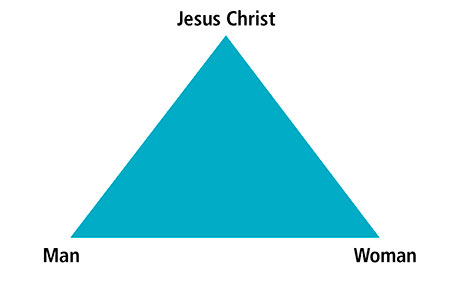
hear all the time is “What would Jesus do?” As cliché as this is, it is a good question to ponder. If I am acting in a way that is not in line with the example of the Savior, I need to re-evaluate and transform my actions and thinking. Something I loved this week was a point made by David A. Bednar. He explained that marriage is like a triangle with the Savior at the top and the husband and wife at each lower corner. As the husband and wife each come closer to the Savior, they also grow closer to each other. I’ve learned over time that the triangle is one of the strongest forms in architecture. If one side is broken, the strength is lost. So we too cannot break the connection between any side of our marital triangle, or the marriage will weaken. I have also learned from personal experience that when I am not doing what I should be to draw closer to the Savior, I am more impatient and unloving towards my husband. By following the example and teachings of the Savior, and working on transforming into a better spouse, I know I can become better at peacefully handling differences and creating more love in my relationship.

Sunday, January 22, 2017

A Plan of Happiness

I attended a funeral yesterday of an amazing man. This man was a father, a husband, a brother, a son, a bishop, a missionary, and a friend. He was an enduring example of Christlike love and service. The chapel where his funeral was held was full of people who had felt the influence of this mans love and kindness in their life. For such a fulfilling life, one might think that he must have been very old, but to the contrary, he was only 66. He was in good health, as far as anyone knew, and died unexpectedly in about a peaceful 10 minutes time.

To most, this seems much too soon to be taken from this earth and while most also might expect his funeral to be full of mourning and confusion, his was not. The messages shared at his funeral were ones of hope and peace. A dear mutual friend of ours and influential leader of the local congregation of our faith in the southern Milwaukee area (a counselor in what we call the stake presidency) gave a eulogy which highlighted the blessings of what many refer to as the plan of happiness. This is a well known doctrine in our church, and one that provides clarity, hope and purpose to life. As a part of this plan, which was laid out by our loving Father in Heaven, we are able to return to live with our families in the presence of God for eternity after we die. I have heard that this is a rather unique concept among religions, and one that brings many to the gospel of Jesus Christ that I believe to be true.

This plan not only provides me with the hope of reuniting with my lost relatives and friends like the one that passed this week, but it clarifies the importance of families on the earth. It is the same plan the Jesus Christ presented in his gospel while on the earth. After time had past when Christ was no longer on the earth, many important parts of this plan were lost and forgotten. People became confused and followed after their own ideas. My church believes that this doctrine was restored through the revelation of a modern day prophet, Joseph Smith. This doctrine emphasizes 3 important "pillars" in the plan of happiness. The creation of the earth and man, the fall of Adam and Eve, and the atonement of Jesus Christ. These three vital occurrences are what allow us to live in families now and forever. Let me explain...

The creation  provided us with a place to live with earthy parents and physical bodies. The fall allowed us all to be born into this world and to experience life at its fullest. Complete with ups and downs, happiness and tears, the gift of agency in our mortal life enables us to create our own families and destinies. Last, the atonement makes our lives worthwhile. It provides us with the gift of being able to return back into the presence of our Heavenly parents, even though we may sin and stumble. We repeat this pattern regularly throughout our own lives. We experience our own creations of children, new jobs and other opportunities. We experience falls as we may stumble, confront failures, challenges and opposition. We then turn to the power of the atonement as we seek for comfort and healing.

I am so grateful to understand a plan that provides clarity and purpose to my earthly life and relationships, and peace and comfort that death is not the end. I have experienced the loss of many loved ones in my life. The most significant was my own mother, who died when I was only 12 years old. I look forward to the day when we can be reunited as an eternal family, along with others who have passed including grandparents, aunts, uncles, brothers, a sister and cousins. The plan that allows this to happen is a plan of salvation, and it truly does bring me happiness in my life.